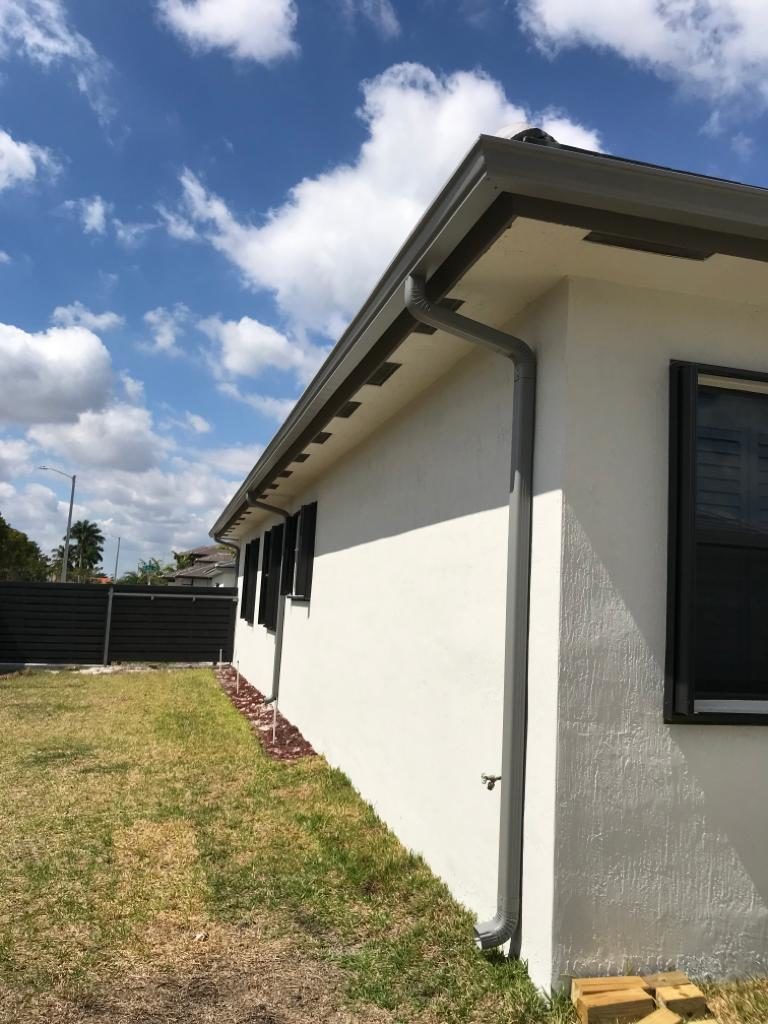
Quick answer
After a Miami storm, your gutters likely need repair if you see sagging sections, gutters pulling away from the fascia, drips from joints or corners, overflow while the gutter is clean, detached or crushed downspouts, or new water stains on walls and soffits. Fixing these early helps keep water away from your fascia, walls and foundation.
Storms are when gutters do their hardest work, and also when weak spots show up. A heavy downpour or strong wind can loosen hangers, crack a seal or knock a downspout off, and you may not notice until water starts showing up where it should not. Here is what to look for, and what each sign usually means.
Safety first
Look from the ground first. Use binoculars or your phone's zoom to inspect the roofline. Avoid climbing a ladder on wet ground, in wind, or near power lines, and never walk on a wet roof. If a gutter is hanging loose over a walkway or entrance, keep people away from it until it is secured.
1. Sagging or bowed sections
A gutter should run in a straight line with a slight slope toward each downspout. If a section dips in the middle or droops at one end, the hangers may have bent or pulled loose under the weight of water and debris.
A sagging gutter holds standing water, which adds weight and makes the sag worse. It can also send water over the edge in exactly the wrong spot.
2. Gutters pulling away from the fascia
Look for a gap between the back of the gutter and the fascia board. Wind can pry gutters outward, and loose fasteners let them drift. When that gap opens, water runs behind the gutter instead of into it, soaking the fascia and the wall below.
If the fascia itself looks soft, swollen or stained, the wood may have been taking on water for a while and should be checked before the gutter is reattached.
Dealing with a gutter problem right now?
Get a free estimate from a Miami seamless gutter specialist.
3. Leaks at joints, corners and outlets
Watch the gutters during the next rain or right after it. Steady drips from corners, end caps or where downspouts connect usually mean a failed seal. On sectional systems, every joint along the run is a possible leak point.
A small drip can seem harmless, but it often lands on the same patch of wall, walkway or landscaping every time it rains. Over a rainy season, that adds up.
4. Overflow even when the gutter is clean
If water spills over the front edge during a downpour and the gutter is not clogged, the problem may be:
- A slope that shifted during the storm, leaving water with nowhere to go.
- A blocked or crushed downspout.
- A gutter that is too small for the roof area or pitch.
Size problems are covered in detail in 6-inch vs 7-inch seamless gutters.
5. Detached, crushed or misdirected downspouts
Downspouts take a beating in storms. Check that each one is attached at the top, secured to the wall, and still emptying away from the house. A downspout that has come loose may dump water directly against the foundation or into a planter bed.
Also check the bottom outlet and any extensions. Debris from the storm can block them.
6. New stains, peeling paint or mildew
Water that escapes the gutter leaves marks. After a storm, look for:
- Dark streaks or stains on stucco below the gutter line.
- Peeling paint on fascia or soffits.
- Mildew or discoloration under eaves.
- Water marks around window frames.
These are often the first visible sign of a hidden leak.
7. Washed-out soil and pooling near the foundation
Look at the ground beneath your gutters. Trenches in mulch, exposed roots, splash marks on the bottom of walls or puddles that linger by the foundation point to water coming off the roof in the wrong place.
8. Visible damage: dents, cracks and rust
Falling branches and wind-blown debris can dent or crack a gutter. On older galvanized gutters, look for rust spots or holes, which are common in humid, salty coastal air. Damaged sections usually need replacement rather than a patch.
Repair or replace?
Not every storm means new gutters. Repair often makes sense when:
- The damage is limited to a few hangers, a corner seal or one downspout.
- The rest of the system is straight, sound and properly sized.
Replacement may be the better choice when:
- Leaks come from many joints along a sectional system.
- Sections are rusted through, cracked or badly bent.
- The gutters overflow because they are undersized.
- Repairs keep coming back after every rainy season.
Seamless Rain Gutters Miami handles both whole-house and partial gutter repairs, and installs new seamless systems when replacement is the smarter move. You can see what we do on our services page.
Do not wait for the next storm
In Miami, the next downpour is rarely far away, especially during the rainy season and hurricane season. A small leak or a loose section left alone can lead to bigger damage to fascia, stucco, landscaping and foundations. If storm season is winding down, our end-of-hurricane-season gutter checklist walks through a full inspection.
Frequently asked questions
How do I know if my gutters were damaged in a storm?
Walk around the house and look for sagging sections, gaps between the gutter and fascia, loose or missing downspouts, dents and debris. During the next rain, watch for drips at joints and overflow. New stains on walls or pooling near the foundation also point to storm damage.
Can a sagging gutter be fixed, or does it need to be replaced?
Many sagging gutters can be fixed by replacing bent or loose hangers and resetting the slope, as long as the gutter itself is not cracked, rusted or badly bent. If the fascia behind it is rotted, that needs attention first. Heavily damaged sections are usually replaced.
Why is water dripping behind my gutter instead of going into it?
Water usually runs behind a gutter when the gutter has pulled away from the fascia, when it is hung too low below the roof edge, or when the roof edge flashing is missing or damaged. This can soak the fascia and stain the wall, so it should be corrected promptly.
Is it safe to clean or repair gutters myself after a storm?
Checking from the ground is safe and useful. Ladder work right after a storm is risky because ground, roofs and ladders are wet, and wind can still be strong. Stay away from power lines and loose sections. For anything beyond a quick visual check, a professional is the safer choice.
Do you repair gutters for businesses as well as homes?
Yes. Seamless Rain Gutters Miami provides gutter repair and maintenance for houses and businesses, including fixes for leaks, overflow and storm damage, on whole buildings or specific sections. We are licensed and insured and available 24/7 for urgent gutter problems.
Free estimate · Available 24/7
Get a free quote
Spotted sagging, leaks or loose downspouts after the last storm? Seamless Rain Gutters Miami is licensed, insured and available 24/7. Call (305) 300-6021 or request a free quote to get your gutters repaired before the next downpour.